CBSE · PARENTS
How to check if your child understands CBSE concepts
Finished homework is not the same as understanding. Use Easy, Medium and Hard checks on one CBSE chapter to see the level your child is actually comfortable at.
19 September 2026 · 6 min read
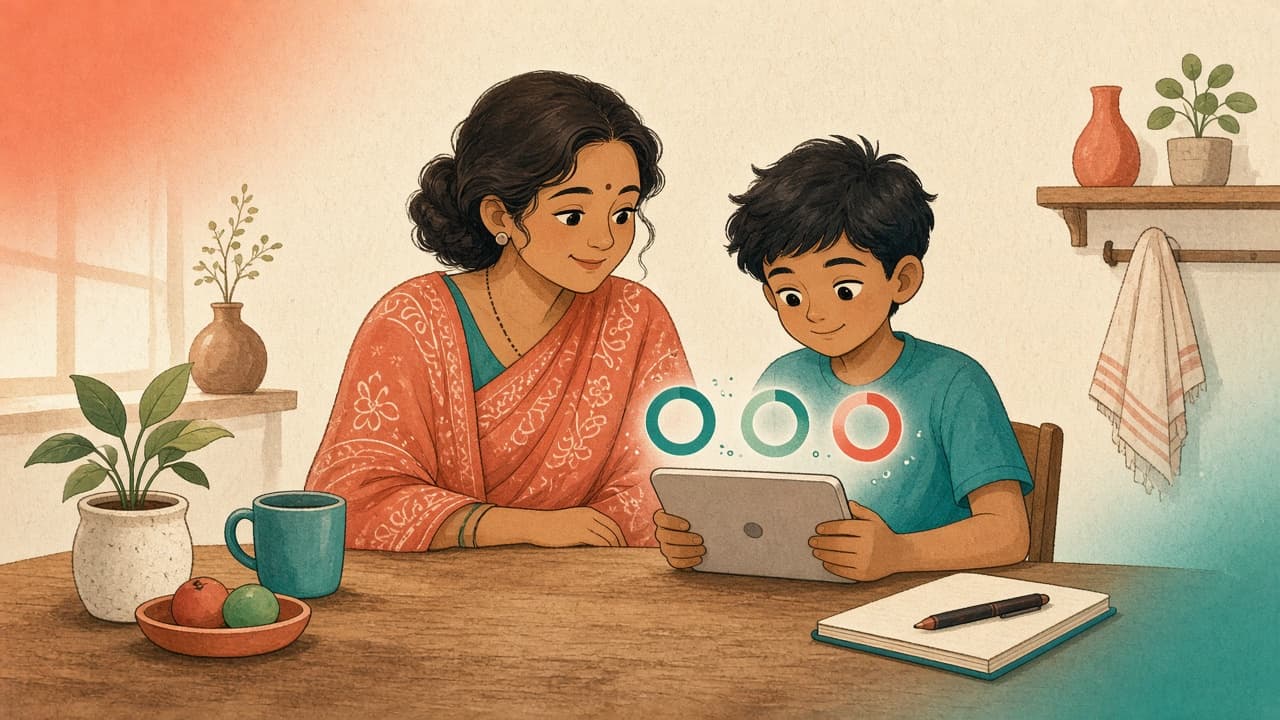
Most CBSE evenings end the same way: the homework is done, the worksheet is filled, and everyone is tired. The question that still sits in the room is quieter — how to check if your child understands CBSE concepts, not just whether the page is complete.
Understanding is not a mood and it is not a single tick. It is whether your child can hold the idea in this chapter when the question is familiar, when it is a little twisted, and when it looks new. That is a different job from “finish the worksheet”.
Finished work is not the same as understood work
A marked paper gives you one number. That number is useful, and it is also easy to misread. A high score can mean the paper was kind. A low score can mean they were tired, rushed, or stuck on one line. Neither tells you the level they are comfortable at inside the chapter.
Parents who search for how to check if a child understands CBSE concepts are usually trying to answer a smaller, kinder question: “Can they do Easy on this chapter? Medium? Hard?” Once you can see that split, you stop assigning a whole new booklet every time something feels shaky.
Easy
Medium
Hard
THREE LEVELS · ONE CHAPTER
Use three understanding checks on one chapter
The practical check is not another full-syllabus test. Pick the exact CBSE chapter that is in play this week — Fractions, Nouns, Nutrition, whatever the class is on — and run three short understanding checks:
- Easy — the basics of this chapter are in place.
- Medium — they can work the chapter without you sitting next to them.
- Hard — the idea still holds when the question is less familiar.
That is the whole picture. If Easy is calm and Medium slips, you know where to stay. If Medium holds and Hard wobbles, you are not “behind” — you have found the next short check, not a reason to restart the term.
Do this on a tablet, in a short sitting. Long papers hide the level inside fatigue. Three checks on one chapter keep the evening small enough that you can actually look at the result.
What free PDF sites do not tell you
Free CBSE PDF sites are easy to find and easy to print. They are also easy to confuse with a check. A download is a file. You still set it, sit through it, and mark it. You still get one score. You still do not know whether the miss was Easy, Medium or Hard.
FREE PDF SITE
You still mark it.
One worksheet. One score. No Easy / Medium / Hard split.
UNDERSTANDING CHECKS
Easy
Medium
Hard
You see the level.
Same chapter, three checks, on the tablet.
Print packs on sites such as cbseworkbook.com are a different product again: physical pages for a desk. They can be extra paper if you want extra paper. They are not a tablet-first way to see the level your child is comfortable at. If your question is how to check understanding, you need the three-level split, not a thicker stack.
How BrainyWorkbook runs the check
BrainyWorkbook is CBSE chapter practice for Classes 1–10. You pick the chapter, work its Easy, Medium and Hard understanding checks on the tablet, and see the level. BrainyBuddy sits alongside so the sitting stays short — company while they practise, not a chat bot and not a tutor.
It runs in the browser, so there is nothing to install. You can start free, no card needed. When you want the full school year for one kid, the price is ₹999 per kid per year — written that way on purpose, because a bare “₹999/kid” reads like a monthly charge. The compact line on the button is ₹999/kid/year.
That is the check, end to end: one chapter, three levels, a result you can act on tonight. No extra syllabus dump. No unmarked PDF pile.
What “understands” sounds like in the room
You do not need a rubric on the fridge. Listen for whether they can start the next similar question without you reading it first. If they can explain the Easy check in one sentence — “this is sharing a whole into equal parts” — the concept has a hook. If they can only point at the worked example in the textbook, they have a memory of a page, not the concept.
Medium is the tell. Medium is where they stop copying the shape of last night’s sum and start choosing a method. Hard is where they notice the idea still applies when the numbers or the wording move. That conversation is the check. The tablet just keeps the sitting short enough that you still have patience to hear it.
If two siblings share a tablet, run one chapter for one child. Mixing classes in one sitting is how “understanding” turns back into a score you cannot read. BrainyWorkbook is priced per kid per year for that reason: the check belongs to one child, one chapter, three levels.
A fifteen-minute routine you can repeat
If you want a habit rather than a speech, keep it this small:
- Name the chapter out loud — “we’re only on Fractions.”
- Do the Easy check. Stop if it is messy; that is already the answer.
- If Easy holds, do Medium. Then Hard, only if Medium is calm.
- Write one line: comfortable at Easy / Medium / Hard.
Tomorrow you do not need a new topic. You need the next level on the same chapter, or the next chapter if all three held. That is how you check if a child understands CBSE concepts without turning the house into a test centre.
Questions parents ask
Is a high homework score enough?
Not on its own. A single paper can be easy for that day. Three understanding checks — Easy, Medium and Hard — on the same chapter show the level your child is genuinely comfortable at.
Do I need to print more worksheets?
No. BrainyWorkbook is tablet-first chapter practice in the browser. You pick the CBSE chapter and work the three checks there.
What does ₹999/kid/year include?
CBSE chapter practice for Classes 1–10, Easy, Medium and Hard understanding checks, and the BrainyBuddy companion. One kid, the full school year — ₹999 per kid per year.
See the level they’re comfortable at
Start free on the tablet · ₹999/kid/year