
CBSE · PARENTS
Easy, Medium, Hard: Does Your Child Really Get Fractions?
Check if your child truly understands fractions: 9 Easy, Medium and Hard questions with answers, 4 common mistakes, quick fixes and a 10-minute routine.
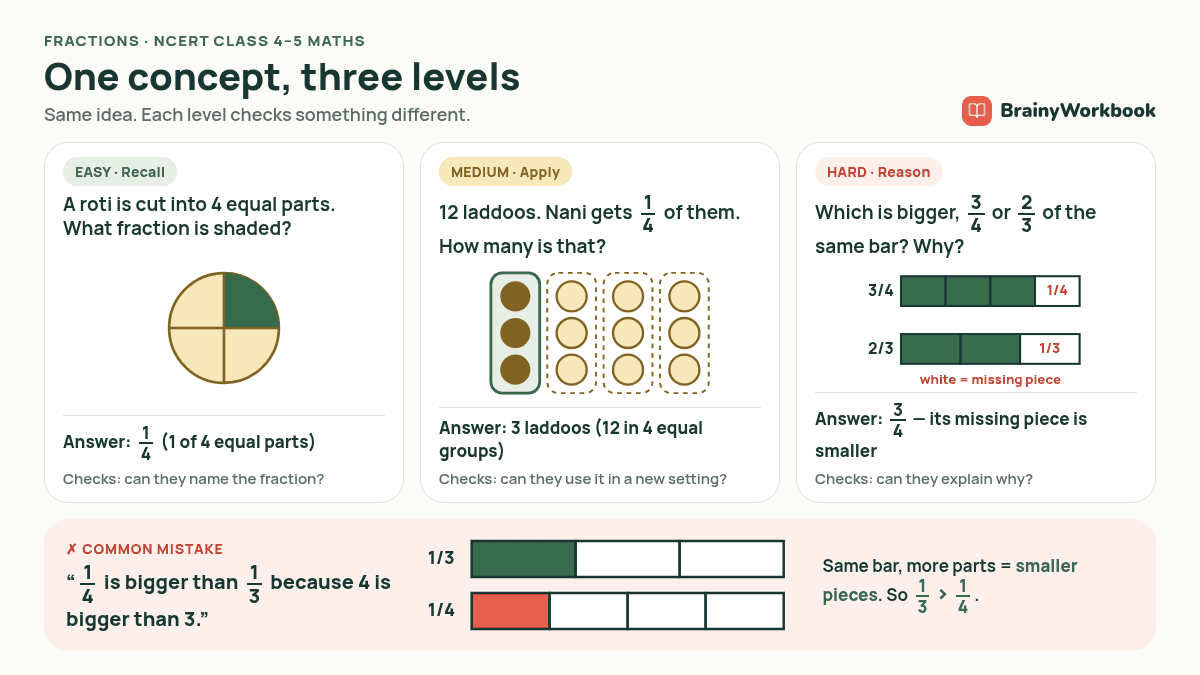
Your child brings home a fractions worksheet. Every answer is right. A week later, you ask, "Would you like 1/3 or 1/4 of this chocolate?" and they pick 1/4 "because it's bigger."
A right worksheet is not understanding. Check in about ten minutes, with a roti and paper. In NCERT Maths Mela, fractions are Class 4, Chapter 5, "Sharing and Measuring", and Class 5, Chapter 2, "Fractions".
What each level actually tests
- Easy checks recall. Can they name it? "This is one quarter. We write it 1/4."
- Medium checks apply. Can they use it on 12 laddoos, or a dosa cut into 8?
- Hard checks reason. Can they explain why, compare, or spot a mistake?
Strong at Easy, stuck at Medium: practise there.
9 sample questions, with what each answer tells you
Let them point, fold or draw.
Easy (recall)
1. A roti is cut into 4 equal parts. One part is shaded. What fraction is shaded?
Answer: 1/4.
What it tells you: "1/4" means the bottom number is the equal parts. "1/3" or "4/1" is Mistake 3.
2. Fold a paper into 2 equal parts. What do we call each part? How do we write it?
Answer: one half, written 1/2.
What it tells you: The word and the symbol should match. "Half" without 1/2 is notation, not the idea.
3. In 3/5, what does the 5 tell us?
Answer: the whole is cut into 5 equal parts.
What it tells you: "5 pieces" needs "Equal?" Skipping it leads to Mistake 2.
Medium (apply)
4. There are 12 laddoos. Nani gets 1/4 of them. How many does she get?
Answer: 3 laddoos.
What it tells you: A fraction of a group, not only a shape. "4" used the bottom number as the answer.
5. A dosa is cut into 8 equal pieces. 3/8 has potato. 5/8 has paneer. Which filling covers more of the dosa?
Answer: paneer, 5/8.
What it tells you: They can compare same-size parts. If not, wait on Hard.
6. Fill in the boxes: 1/2 = ☐/4 = ☐/8.
Answer: 2/4 and 4/8.
What it tells you: One amount, many names. Folding shows it. A rule alone is not enough.
Hard (reason)
7. Which is bigger, 3/4 or 2/3 of the same bar? How do you know?
Answer: 3/4.
What it tells you: A great answer is, "3/4 is missing one quarter. 2/3 is missing one third. A quarter is smaller, so 3/4 is closer to the whole bar." A drawing counts.
8. Meena says half of her chocolate is bigger than half of her brother's chocolate. Can she be right?
Answer: yes, if her chocolate is bigger to start with.
What it tells you: The fraction depends on the whole. Class 5 NCERT opens with this puzzle.
9. Is 5/4 of a roti more or less than one whole roti? Show it.
Answer: more. 4/4 is one whole roti, and there is 1/4 extra.
What it tells you: A fraction need not be a small piece. Fine to miss in Class 4.
The 4 most common fraction mistakes, and a 2-minute fix for each
Mistake 1: "1/4 is bigger than 1/3, because 4 is bigger than 3"
How to spot it: Ask, "Would you rather have 1/3 or 1/4 of your favourite chocolate?" Choosing 1/4 to get "more" means you found it.
2-minute fix: Two equal strips. Fold one into 3, one into 4. Tear one part from each and lay them side by side. "More parts means smaller pieces."
Mistake 2: Counting parts that are not equal
How to spot it: Draw a circle split into 4 unequal pieces. Shade one. Ask, "Is this 1/4?" Yes means equal has not landed.
2-minute fix: Cut a roti into 4 uneven pieces. Ask, "If four people share this, is it fair?" Then cut another roti into 4 equal pieces. A fraction is a fair share.
Mistake 3: Writing the fraction the wrong way
How to spot it: Shade 1 of 4 equal parts. Watch for 1/3 (shaded over unshaded) or 4/1 (upside down).
2-minute fix: Say together: "Top is how many I take. Bottom is how many equal parts in all." Three times on paper, sentence first, then the fraction.
Mistake 4: Thinking 2/4 is more than 1/2
How to spot it: Ask, "Do you want half of this paper, or two quarters?" "Two sounds like more" is the mistake. Class 4 NCERT starts with two sisters and this choice.
2-minute fix: Shade half a paper. Fold again and open it: two shaded quarters. Same paper, new name. Ask, "Did the shaded part grow?"
When to move up a level
Use one rule: three right, one reason, two days.
They explain one answer in their own words, on two days. One good evening can be luck. Two means learning.
Miss 2 of 3 at a new level? Step back a few days.
A 10-minute routine for tonight
You need a roti or a paper strip, a pencil and a small card.
- Minutes 0–2: Warm up at Easy. One real-object question. Start with a win.
- Minutes 2–6: Two questions at their current level. Think out loud. Listen. Do not correct yet.
- Minutes 6–8: One stretch question from the next level. Say, "This one is tricky. Let's just try." No marks.
- Minutes 8–10: Teach-back and note. They teach one answer. Note the mistake. Start there tomorrow.
After a week, you can see which mistake returns.
FAQ
My child gets fractions right at school but wrong at home. Why?
A repeated format, like shaded circles, can hide the idea. Try laddoos or a ribbon.
Should I teach a quick trick for comparing fractions?
Use strips, rotis and folding until the picture is solid. A shortcut makes sense once they can say why 1/3 is bigger than 1/4.
My child is in Class 4. Are Hard questions too much?
Some are a Class 5 idea: comparing, and fractions bigger than one. One Hard question is enough. Enjoying it is a good sign.
Sources
- NCERT, Maths Mela, Grade 4, Chapter 5 "Sharing and Measuring" (Parts and Wholes): https://ncert.nic.in/textbook/pdf/demm105.pdf
- NCERT, Maths Mela, Grade 5, contents and Chapter 2 "Fractions": https://ncert.nic.in/textbook/pdf/eemm1ps.pdf and https://ncert.nic.in/textbook/pdf/eemm102.pdf
BrainyWorkbook tests each chapter at Easy, Medium and Hard.
Start free